Common Ignition Coil Failures in British Luxury Cars - Symptoms & Fixes
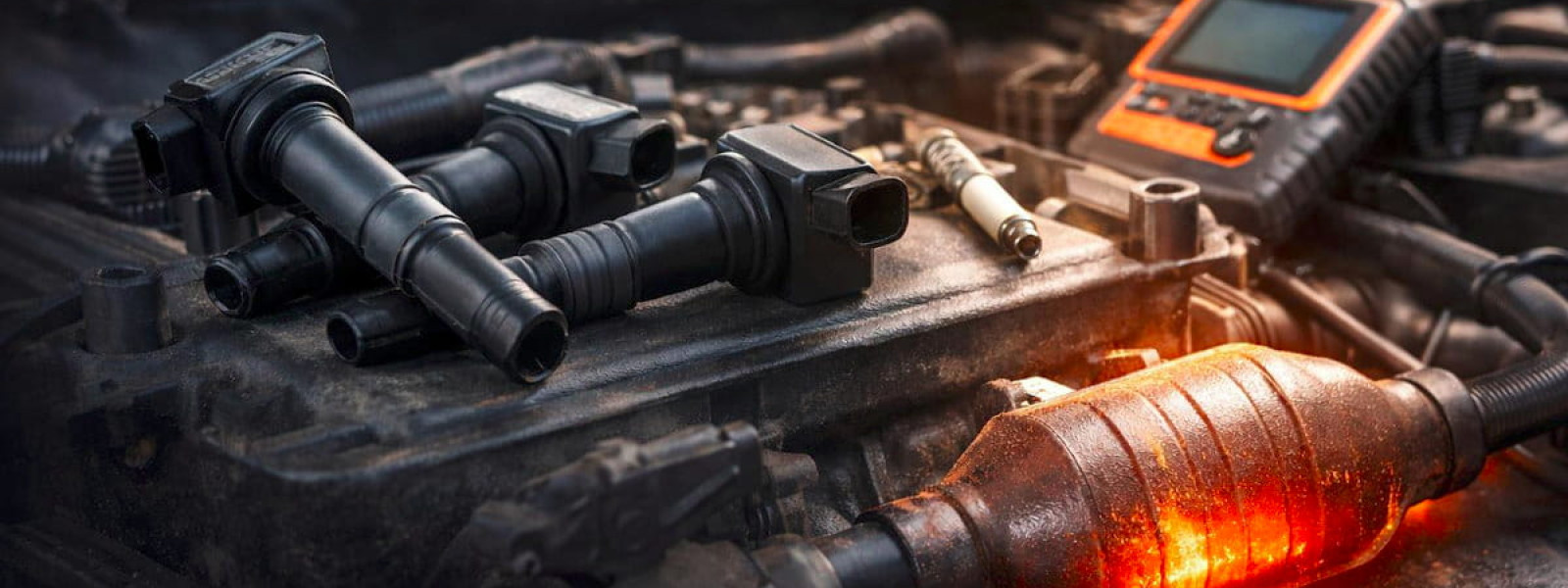
Ignition coil failures are a common cause of misfires in modern premium vehicles. The root issue is not brand-specific, but related to insulation aging, thermal cycling, vibration, and increasing voltage demand required to break down the spark plug gap under real operating conditions.
In British luxury vehicles such as Jaguar, Land Rover, and Bentley, tightly packaged engines and elevated under-hood temperatures accelerate these aging processes. While engine control units may briefly stabilize combustion through timing and fueling adjustments, persistent ignition instability is quickly detected by misfire monitoring systems. Left unresolved, repeated misfires can overheat catalytic converters and lead to costly secondary damage.
What Does an Ignition Coil Do?
An ignition coil is responsible for converting low battery voltage into the high-voltage spark required to ignite the air-fuel mixture inside each cylinder. In modern luxury engines, each cylinder is typically controlled by its own coil, allowing the engine control unit (ECU) to precisely manage timing, combustion efficiency, and emissions.
In British luxury vehicles, ignition coils must perform consistently under demanding conditions:
- High under-hood temperatures
- Turbocharged or supercharged engines
- Tight tolerances and high compression ratios
- Sophisticated ECU logic that adapts to driving conditions
While the ECU can compensate for minor ignition inconsistencies in the short term, this adaptive behavior often delays visible symptoms. By the time a driver notices rough idle, hesitation under load, or a flashing check engine light, the coil has usually degraded beyond recovery.
This is why ignition coil failures in luxury vehicles rarely happen suddenly — they develop gradually, often unnoticed, until performance and drivability are clearly affected.
Why British Luxury Cars Are More Prone to Ignition Coil Failures
British luxury vehicles are engineered for performance, refinement, and efficiency — but these same characteristics place additional stress on ignition components. Compared to mass-market vehicles, ignition coils in premium British cars operate closer to their thermal and electrical limits on a daily basis.
High Thermal Load
Turbocharged and high-compression engines generate significantly more heat. In tightly packaged engine bays, ignition coils are exposed to prolonged heat soak, especially after short trips where temperatures spike but airflow is limited. Over time, this heat degrades internal coil insulation, leading to intermittent misfires and voltage leakage.
Tight Engine Packaging
Luxury vehicles prioritize compact layouts for performance and weight distribution. As a result, ignition coils are often positioned close to exhaust components or turbochargers. This proximity accelerates aging and increases the likelihood of heat-related failures.
Advanced Engine Management Systems
Modern ECUs are designed to adapt. When a coil begins to weaken, the system may temporarily compensate by adjusting ignition timing or fuel delivery. While this preserves drivability in the short term, it also masks early warning signs — allowing the coil to degrade further before a fault becomes obvious.
Oil and Moisture Contamination
Minor oil leaks from valve cover gaskets can allow oil to enter spark plug wells, compromising coil boots and electrical connections. In Canadian climates, moisture intrusion and condensation further increase the risk of corrosion and short circuits, particularly during cold starts and freeze-thaw cycles.
Canadian Driving Conditions
Cold weather starts place additional strain on ignition systems. Higher resistance during ignition events, combined with moisture and short-distance driving, creates ideal conditions for premature coil failure — especially during winter months.
In combination, these factors explain why ignition coil issues are not an exception but a recurring service concern in British luxury vehicles. Recognizing this vulnerability early allows for targeted diagnostics and prevents more costly downstream damage.
Common Symptoms of a Failing Ignition Coil
Ignition coil failures rarely present as a sudden, complete breakdown. In most British luxury vehicles, the failure progresses gradually, with symptoms becoming more pronounced over time. Because modern ECUs attempt to compensate for ignition irregularities, early signs are often subtle and easy to ignore.
Below are the most common warning signs observed in premium British vehicles.
Engine Misfire (P0300–P030X)
One of the earliest and most frequent indicators is a misfire fault code. This may occur under load, during acceleration, or at idle. A single failing coil can trigger misfire codes across multiple cylinders, particularly in tightly integrated ignition systems.
Rough Idle and Engine Vibration
A weakened ignition coil struggles to deliver consistent spark energy, especially at low engine speeds. This often results in uneven idle, noticeable vibration through the cabin, or a sensation that the engine is “running rough,” particularly when stopped at lights.
Hesitation Under Acceleration
Under increased demand — such as merging onto a highway or climbing an incline — a failing coil may not provide sufficient spark voltage. The result is hesitation, stumbling, or delayed throttle response, even though the vehicle may otherwise feel normal during steady cruising.
Flashing Check Engine Light
A flashing check engine light indicates an active misfire that can damage the catalytic converter. In luxury vehicles, this warning may appear intermittently at first, then become more frequent as the coil deteriorates.
Increased Fuel Consumption
Incomplete combustion caused by weak ignition forces the ECU to compensate by adjusting fuel delivery. Over time, this leads to higher fuel consumption and reduced efficiency, often without any obvious change in driving style.
Fuel Odor from the Exhaust
Unburned fuel entering the exhaust system can produce a noticeable fuel smell. This symptom suggests that combustion is no longer occurring consistently and should be addressed immediately to avoid catalyst damage.
It is important to note that even when symptoms appear mild, continued operation with a failing ignition coil can result in escalating mechanical and emissions-related issues. Early diagnosis is always more cost-effective than reactive repair.
Ignition Coil Problems by Brand
While ignition coil failures share common symptoms across most vehicles, British luxury brands each have their own patterns of failure. Engine architecture, packaging, and operating conditions all influence how and when coils begin to degrade.
Jaguar Ignition Coil Issues
Jaguar engines are known for smooth power delivery and high specific output, but these characteristics also place increased demand on ignition components.
Common contributing factors include:
- Elevated under-hood temperatures in V6 and V8 platforms
- Turbocharged Ingenium engines with higher ignition load
- Sensitivity to incorrect spark plug specifications
A common scenario involves intermittent misfires that appear only under acceleration or during cold starts. Because the ECU can temporarily compensate, fault codes may be inconsistent, leading some repairs to focus on individual coils rather than the broader ignition system.
In our experience, Jaguar ignition coil failures are often accompanied by marginal spark plugs or early oil seepage into the plug wells. Addressing only the failed coil without correcting these underlying issues frequently results in repeat faults.
Land Rover Ignition Coil Problems
Land Rover vehicles combine luxury with off-road capability, which introduces additional environmental and mechanical stresses.
Typical causes include:
- Heat soak from short-trip driving
- Moisture intrusion and condensation
- Oil contamination from valve cover gasket seepage
Misfires are commonly reported during cold starts or low-speed driving, particularly in Canadian winter conditions. In some cases, drivers notice hesitation or vibration without an immediate check engine light, as the ECU attempts to stabilize combustion.
Land Rover ignition coil issues often stem from a combination of environmental exposure and gradual insulation breakdown. Proper diagnosis requires inspection beyond fault codes, including plug wells, coil boots, and wiring integrity.
Bentley Ignition Coil Failures
Bentley engines operate at the highest end of thermal and performance demands. W12 and twin-turbo V8 platforms generate significant heat, and ignition coils are densely packaged within the engine bay.
Key risk factors include:
- Extreme and sustained thermal load
- Limited airflow around ignition components
- Cascading fault codes triggered by a single failing coil
A single degraded coil in a Bentley can lead to multiple misfire codes, drivability complaints, and misleading diagnostic results if not approached correctly. Replacing individual components without a system-level evaluation often leads to incomplete repairs and unnecessary expense.
For these vehicles, precise diagnostics and the use of approved ignition components are essential to maintaining engine balance, performance, and emissions compliance.
Can You Drive with a Bad Ignition Coil?
In some cases, a vehicle with a failing ignition coil may still appear drivable. The engine starts, the car moves, and the issue may only surface intermittently. This often leads drivers to postpone inspection, especially if the warning light disappears on its own.
However, continuing to drive with a bad ignition coil carries increasing risk — particularly in British luxury vehicles.
Short-Term Driving
In the early stages of coil degradation, the ECU may compensate by adjusting ignition timing and fuel delivery. This can mask symptoms temporarily, allowing the vehicle to operate with only mild roughness or hesitation. While this may feel manageable, the underlying problem continues to worsen.
Long-Term Consequences
Persistent misfires allow unburned fuel to enter the exhaust system. Over time, this can:
- Overheat and damage the catalytic converter
- Increase emissions-related faults
- Cause uneven engine loading
- Lead to fuel wash on cylinder walls
In high-performance luxury engines, these secondary issues can escalate quickly and result in repairs far more costly than addressing the ignition coil early.
When Driving Is Not Recommended
If the check engine light is flashing, or if misfires are frequent and noticeable, driving should be avoided. A flashing warning indicates an active misfire that can cause immediate catalytic damage.
The safest approach is prompt diagnostic assessment. Addressing ignition coil issues early not only restores performance but also protects critical engine and emissions components from avoidable damage.
Common Repair Mistakes We See
Ignition coil issues in British luxury vehicles are frequently misdiagnosed or improperly repaired. While the symptoms may appear straightforward, the underlying causes are often more complex than a single faulty component.
Below are the most common mistakes we encounter.
Replacing Only One Ignition Coil
While a single coil may trigger a fault code, others are often at a similar stage of degradation. Replacing just one coil can lead to repeated misfires and return visits, as additional coils fail shortly afterward.
Using Aftermarket or Non-Approved Components
Luxury engines are calibrated for specific ignition characteristics. Aftermarket coils that do not meet OEM specifications can cause inconsistent spark delivery, triggering new fault codes or drivability issues even after replacement.
Ignoring Spark Plug Compatibility
Incorrect spark plugs — wrong heat range, gap, or specification — place additional stress on ignition coils. In many cases, repeated coil failures can be traced back to mismatched or worn plugs that were never addressed.
Overlooking Oil and Moisture Contamination
Oil intrusion from valve cover gasket leaks and moisture accumulation in spark plug wells are common contributors to ignition failure. Replacing coils without correcting these conditions almost guarantees recurrence.
Skipping ECU Reset and Verification
Modern engine management systems require verification after ignition repairs. Without clearing adaptations and confirming proper operation, residual faults may remain undetected until symptoms return.
These mistakes often result in incomplete repairs, unnecessary component replacement, and avoidable long-term damage. Proper diagnosis and system-level evaluation are essential, especially in high-performance British luxury vehicles.
Proper Diagnosis & Fix — The Westminstor Motors Approach
Diagnosing ignition coil failures in British luxury vehicles requires more than reading fault codes. Because these engines rely on adaptive control systems and tightly integrated ignition components, a proper repair begins with understanding the entire system, not just the symptom.
Manufacturer-Level Diagnostics
We use manufacturer-level diagnostic equipment to analyze misfire patterns, coil performance, and real-time engine data. This allows us to identify whether a fault is isolated to a single cylinder or part of a broader ignition imbalance.
Cylinder-Specific Testing
Each ignition coil is evaluated under operating conditions. This includes load-based testing, cold-start behavior, and heat-soak scenarios — all common triggers for coil failures in Canadian driving conditions.
Spark Plug and Coil Compatibility Checks
Ignition coils and spark plugs must work as a matched system. We verify correct specifications, heat range, and gap to ensure the ignition system operates within engineered tolerances, reducing stress on new components.
Inspection for Oil and Moisture Intrusion
Valve cover gasket leaks and moisture accumulation are addressed before coil replacement. Ignoring these factors often leads to premature failure of newly installed parts.
OEM or Approved Components Only
British luxury engines are calibrated for specific ignition characteristics. Using OEM or manufacturer-approved components ensures proper spark energy delivery, stable combustion, and long-term reliability.
Post-Repair Verification
After repairs are completed, the ignition system is re-evaluated under real driving conditions. ECU adaptations are cleared where required, and performance is verified to ensure consistent operation across all cylinders.
This structured, system-based approach minimizes repeat failures, protects engine and emissions components, and restores the vehicle’s intended performance and refinement.
When to Replace Ignition Coils Preventively
Unlike sudden mechanical failures, ignition coil degradation is typically gradual. In British luxury vehicles, waiting for a complete failure is rarely the most cost-effective or reliable strategy. Preventive replacement, when done at the right time and for the right reasons, can help avoid misfires, drivability issues, and secondary engine damage.
Mileage-Based Considerations
While ignition coil lifespan varies by model and driving conditions, many begin to show signs of wear between 80,000 and 120,000 kilometres. Vehicles subjected to frequent short trips or heavy urban driving may experience earlier degradation due to repeated heat cycles.
Heat-Related Aging
Coils exposed to sustained under-hood heat — particularly in turbocharged engines — can lose insulation integrity over time. Even if no fault codes are present, aging coils may struggle under load or during cold starts.
Before Seasonal Stress
In Canadian climates, winter places additional strain on ignition systems. Replacing marginal coils before cold weather can reduce the likelihood of cold-start misfires and intermittent winter-related faults.
During Related Maintenance
Ignition coil replacement is often most efficient when performed alongside spark plug service or valve cover gasket repairs. Addressing the system as a whole minimizes labor duplication and improves long-term reliability.
Before Long Trips or Heavy Use
For vehicles used for extended highway travel or towing, ensuring ignition components are operating at full capacity reduces the risk of performance loss or warning lights during critical driving situations.
Preventive replacement should always be guided by diagnostic evaluation rather than mileage alone. A targeted approach preserves performance while avoiding unnecessary component replacement.
Frequently Asked Questions About Ignition Coil Failures
What causes ignition coils to fail in luxury vehicles?
Ignition coils fail primarily due to heat, electrical stress, and insulation breakdown. In British luxury vehicles, tight engine packaging, turbocharging, and high operating temperatures accelerate this process compared to mass-market cars.
Can a bad ignition coil damage my engine?
Yes. Persistent misfires can allow unburned fuel to enter the exhaust system, potentially damaging the catalytic converter and causing uneven engine loading. Over time, this can lead to costly secondary repairs.
Should I replace all ignition coils at once?
Not always, but it is often recommended when multiple coils show similar wear or when mileage and operating conditions suggest system-wide aging. Replacing coils as a matched set can reduce repeat failures and improve long-term reliability.
Why does my check engine light flash instead of staying on?
A flashing check engine light typically indicates an active misfire that can cause immediate damage to the catalytic converter. This condition should be addressed as soon as possible.
Can cold weather cause ignition coil problems?
Cold weather itself does not damage ignition coils, but it increases electrical demand during startup. Marginal or aging coils often fail under these conditions, making winter a common time for symptoms to appear.
Are aftermarket ignition coils safe for luxury cars?
Aftermarket coils that do not meet manufacturer specifications can cause inconsistent ignition performance. In luxury vehicles, this may lead to new fault codes, drivability issues, or shortened component lifespan.
How do you properly diagnose ignition coil issues?
Accurate diagnosis requires manufacturer-level diagnostics, cylinder-specific testing, and inspection for contributing factors such as oil or moisture contamination. Fault codes alone are rarely sufficient.
Final Thoughts
Ignition coil failures in British luxury vehicles are rarely isolated or random events. They are typically the result of gradual wear, heat exposure, and system-level stress that develops over time. While early symptoms may seem minor, ignoring them can lead to more serious performance and emissions-related issues.
A precise diagnostic approach is essential — especially in vehicles engineered with tight tolerances and advanced engine management systems. Addressing ignition coil problems early helps preserve engine balance, protect critical components, and maintain the refined driving experience these vehicles are designed to deliver.
If your Jaguar, Land Rover, or Bentley is showing signs of misfire, hesitation, or an intermittent check engine light, a professional diagnostic assessment can prevent far more costly damage. The technicians at Westminstor Motors specialize in British luxury vehicles and approach ignition system repairs with manufacturer-level precision and care.
Author: Avo Demirjian